




Connect.camp
Client:
Mentorpedia pvt ltd
Role:
Co-Founder, Product Designer
Year:
2024
Connect.Camp
A university networking platform built in full — and never released
Role: Founder, Product Designer & Team Lead Timeline: 2024 — developed alongside Mentorpedia Platform: Mobile App Status: Never Released
The Problem
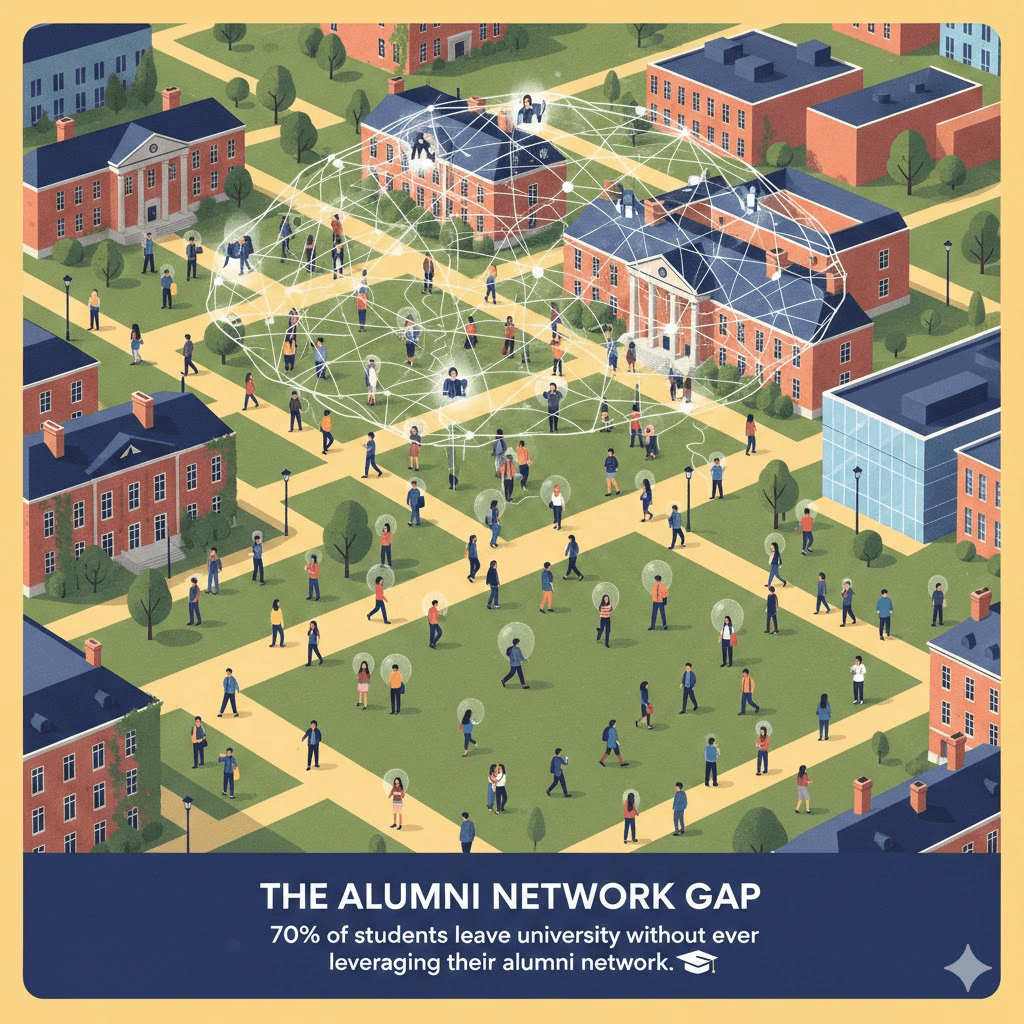
Universities are where careers begin — but most students leave without ever truly leveraging the network they built there. Alumni connections go unmade. Collaboration opportunities pass by. Students with similar goals never find each other.
Professional networking platforms like LinkedIn exist, but they weren't built for students. They're optimised for people who already have careers — not for the 20-year-old trying to figure out what their career should be.
While building Mentorpedia, we kept hearing the same thing from students: "I know the connections I need are somewhere in my university — I just can't find them."
Connect.Camp was built to solve that.
Problem Statement
The Vision
Connect.Camp was envisioned as a university-level professional networking app — a space where students, alumni, and mentors could find each other based on shared goals, skills, and ambitions rather than just mutual connections.
Where LinkedIn was built for who you've already become, Connect.Camp was built for who you're becoming.
It was also designed as a natural extension of the Mentorpedia ecosystem — a funnel that would bring students into structured mentorship at exactly the moment they needed it most.
My Role
As founder and sole product designer, I owned the entire design lifecycle while simultaneously running Mentorpedia operations:
Conducted user interviews with university students across multiple campuses to identify pain points
Designed the app from the ground up — information architecture, flows, UI, and prototype
Worked closely with developers to ensure performance matched the experience design
Managed timelines and resources across two simultaneous products
Defined the strategic positioning of Connect.Camp within the Mentorpedia ecosystem
Core Features Designed
Professional Student Profiles Students could showcase academic achievements, projects, skills, and career goals — a profile built for someone at the beginning of their professional journey, not the middle of it.
Peer & Alumni Networking Discovery built around shared interests, goals, and fields — not just mutual connections. A CS student could find alumni working at their dream company. A design student could find peers working on side projects.
Mentorpedia Integration Mentorship was embedded directly into the app — when a student found someone they admired, booking a structured session was one tap away. Connect.Camp fed directly into Mentorpedia's mentor network.
Campus Collaboration Tools Groups, events, and project collaboration spaces built around the university ecosystem — giving students a professional context for the work they were already doing together.
Skill Endorsements Peers and professors could endorse skills with context — creating credible, human validation that felt more meaningful than a LinkedIn endorsement from someone you met once at a conference.
Core Product Screens
Your strongest 2-3 screens — student profile, discovery feed, or the mentor integration flow. Show in mobile device mockups.
The Design Process
Starting with the student mental model Students don't think about networking the way professionals do. They think about: who's working on something interesting, who's been where I want to go, and who do I actually want to talk to. The IA was built around these three questions.
Designing for trust at a campus level University networks are tight and reputation-sensitive. Students needed to feel safe putting their ambitions and work on display. Every profile element, every endorsement mechanic, and every messaging flow was designed with that social context in mind.
Balancing two products simultaneously This was the hardest design constraint I've ever worked under. Every decision had to be made with Mentorpedia's resource situation in mind — which features were essential, which were nice-to-have, and which could be cut without compromising the core value.
Ecosystem thinking Connect.Camp wasn't designed in isolation. Every flow had an intentional handoff point to Mentorpedia — the moment a student found a mentor-worthy connection, the path to booking a session was frictionless.
Design Process
A user flow diagram showing how Connect.Camp fed into Mentorpedia — the ecosystem thinking made visual. Or a wireframe progression of the discovery screen.
Why It Was Never Released
As Mentorpedia struggled to find product-market fit and resources ran thin, a hard decision had to be made: focus everything on one product or risk losing both.
We chose to focus on Mentorpedia. Connect.Camp — fully designed, fully developed — was shelved.
It was one of the hardest product decisions of my career. Not because the work was lost, but because I genuinely believed in what it could have been.
The Unreleased Product
What This Project Taught Me
Ecosystem thinking is a design superpower. The most interesting design challenge on Connect.Camp wasn't any individual screen — it was how the product connected to Mentorpedia at exactly the right moment in the user journey.
Resource constraints are a design brief. Building Connect.Camp alongside a live product taught me to make faster, sharper decisions. Every feature had to earn its place. That discipline made me a better designer.
Unreleased doesn't mean wasted. Every design decision, every user interview, every iteration on Connect.Camp informed how I approached future products. The thinking doesn't disappear when the product doesn't ship.
Knowing when to stop is a product skill. Stopping Connect.Camp wasn't giving up — it was a resource allocation decision made with clarity about what mattered most. That kind of judgment is harder than shipping.
Reflection
Connect.Camp remains one of the projects I'm most proud of — not because it launched, but because of the clarity of thinking it required and the ambition it represented.
It was a reminder that the best product ideas aren't always the ones that make it to market. Sometimes they live in the decisions that shaped the designer who built them.
Connect.Camp — Designed 2024. Never release